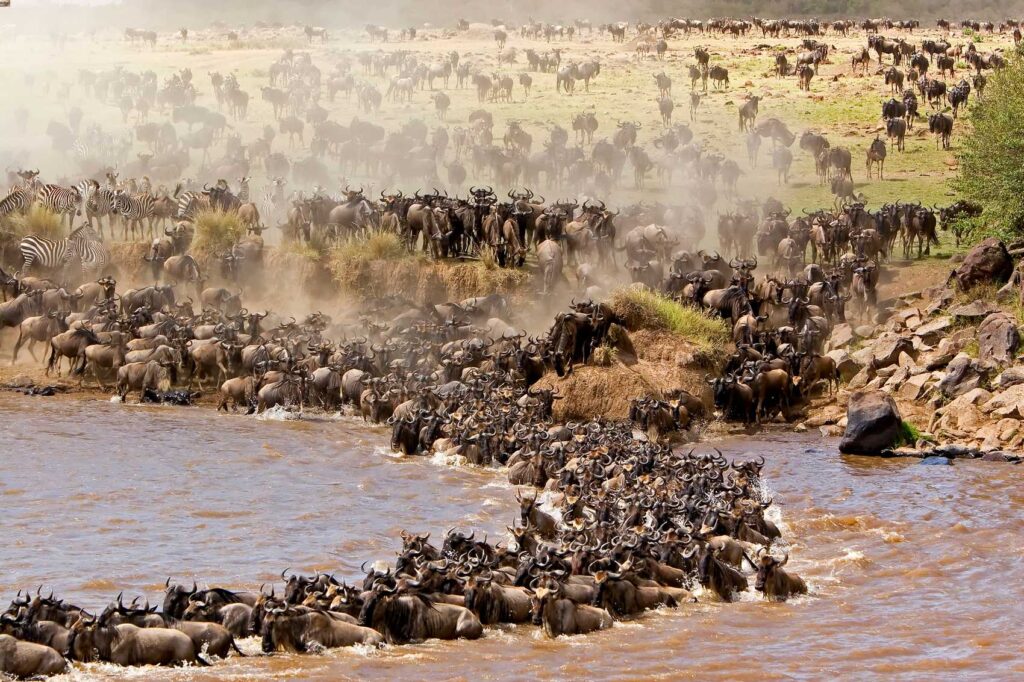
If you’re wondering about the best time to visit Serengeti, the answer depends on what you want to experience. The Serengeti is a year-round safari destination, but wildlife movements, rainfall, landscapes and visitor numbers change throughout the year.
Some travellers come for the Great Migration and dramatic river crossings. Others want to experience the incredible calving season, see predators hunting newborn wildebeest, enjoy excellent big-cat viewing, photograph green landscapes or travel during a quieter period.
The most important thing to understand is that the Great Migration does not follow a fixed calendar. The herds respond to rainfall and the availability of fresh grass, so their location can vary from year to year.
In this guide, we’ll break down when to visit Serengeti National Park month by month, explain the different seasons and show you which period may be best for your safari.
When Is the Best Time to Visit the Serengeti?
For many first-time visitors, June to October is considered an excellent period for a Serengeti safari. This is the main dry-season period, when vegetation is generally thinner, wildlife can be easier to spot and the Great Migration is moving through the western and northern parts of the ecosystem.
However, that doesn’t mean June to October is automatically the best time for everyone.
If your priority is calving season and predator action, January to March can be spectacular. If you prefer lush scenery, fewer visitors and potentially lower accommodation rates, parts of the green season can be very rewarding.
Quick guide
| Your priority | Recommended period |
|---|---|
| Great Migration | June–October |
| Mara River crossings | July–September, with timing unpredictable |
| Calving season | January–March |
| Predator action | January–March |
| General wildlife viewing | June–October |
| Green landscapes | November–May |
| Fewer visitors | April–May and some green-season periods |
| Birdwatching | Wet/green season |
| Lower-season travel | April–May and other quieter periods |
The right answer therefore isn’t simply “What is the best month?” but “What do you want to see, and which part of the Serengeti should you visit at that time?”
Understanding the Serengeti Seasons
Before looking at each month, it helps to understand the broad seasonal pattern.
Dry Season: June to October
The dry season is one of the most popular times for a Tanzania safari.
As water becomes less abundant and vegetation thins, animals often become easier to locate around remaining water sources. The period also overlaps with some of the most sought-after stages of the Great Migration.
The trade-off is that popular areas can become busy, particularly around major wildlife sightings and migration hotspots.
Short Rains: November and December
The short rains generally arrive around November and December. These rains help rejuvenate the landscape and encourage the migration to move south toward the southern Serengeti and Ndutu area.
The landscape becomes increasingly green, while visitor numbers can be lower than during the peak dry season.
Green Season and Long Rains: January to May
January through May brings an important combination of rain, fresh grass and wildlife activity.
The southern Serengeti and Ndutu area become particularly important from December through April, when large herds gather and calving takes place.
March to May generally receives the heaviest rainfall. April and May can therefore be excellent choices for travellers who value greener scenery, fewer visitors and potentially better rates, while accepting a greater chance of rain.
Best Time to Visit Serengeti Month by Month
January — Green Landscapes and the Beginning of Calving Season
January is an exciting time to visit the southern Serengeti.
The seasonal rains have helped create fresh grazing, attracting large numbers of wildebeest and zebra to the southern plains and Ndutu area. Wildlife density in southeastern Serengeti is particularly high from December through April.
As calving season approaches, predators such as lions, cheetahs and hyenas are drawn to areas with large concentrations of young animals.
January is best for:
- Green landscapes
- Large herds
- Big cats
- Photography
- Early calving activity
- A more seasonal Serengeti experience
February — Calving Season at Its Best
For travellers interested in calving season, February is one of the most exciting times to visit.
The southern Serengeti and Ndutu ecosystem can host enormous concentrations of wildebeest and zebra. Thousands of calves are born during this period, creating opportunities to witness both new life and intense predator activity.
Lions, cheetahs and hyenas take advantage of the abundance of vulnerable young animals.
February is best for:
- Wildebeest calving
- Predator sightings
- Wildlife photography
- Southern Serengeti
- Families of animals with young
Eve On Safari recommendation: If your dream safari involves newborn wildebeest and predator action, February deserves serious consideration.
March — Late Calving and Excellent Wildlife
March can still provide excellent calving-season experiences, particularly in the southern Serengeti.
The rains continue to support green vegetation and large concentrations of herbivores. As conditions change, however, the herds gradually begin moving in search of fresh grazing.
March can also be an interesting month for travellers who want excellent wildlife without necessarily planning their entire safari around a river crossing.
March is best for:
- Calving
- Predators
- Green scenery
- Wildlife photography
- Southern and central Serengeti
April — Green Season and Fewer Visitors
April falls within the long-rain period and can be a quieter time to explore the Serengeti.
The landscape is lush and green, making it particularly attractive to photographers. Large herds can still be found in the southern and central areas as the migration continues its seasonal movement.
Rain is the main consideration. April is one of the wetter months, although rainfall does not necessarily mean rain all day.
April is best for:
- Green landscapes
- Photography
- Fewer visitors
- Potentially lower-season rates
- Travellers who don’t mind rain
May — Western Corridor and Migration Movement
May is an important transition period.
The wildebeest begin their movement away from the southern plains toward the Western Corridor. The exact timing depends on rainfall and grazing conditions.
The Western Corridor follows the Grumeti River and is an important section of the migration route. May to July is the main period when migrating herds pass through this area.
May is best for:
- Migration movement
- Western Corridor
- Grumeti area
- Green scenery
- Quieter safari experiences
June — Start of the Dry Season
June marks the beginning of one of the most popular periods for a Serengeti safari.
The weather generally becomes drier, vegetation begins to thin and the migrating herds continue northward through the ecosystem.
The Western Corridor can be particularly interesting during this period as the migration progresses toward the northern Serengeti.
June is best for:
- Great Migration
- Western Corridor
- Grumeti area
- General wildlife viewing
- Comfortable dry-season conditions
July — Northern Serengeti and Migration
July is one of the most popular months for a Serengeti safari.
The migrating herds can be moving through the northern Serengeti, and this is when interest in the famous Mara River crossings begins to rise.
However, it is important to understand that seeing a river crossing cannot be guaranteed. The animals may remain in one area for days or change direction depending on conditions.
July is best for:
- Great Migration
- Northern Serengeti
- Mara River area
- Dry weather
- Excellent general wildlife viewing
August — Peak Migration Interest
August is one of the most sought-after months for travellers hoping to experience the Great Migration in the northern Serengeti.
The Mara River region can offer extraordinary wildlife experiences as migrating herds move between grazing areas. The Serengeti Mara area is particularly associated with migration activity from July to September.
But remember: the migration is nature, not a scheduled event.
You can choose the right month and area, but no safari company can honestly guarantee that a wildebeest herd will cross the river at a particular time.
August is best for:
- Great Migration
- Northern Serengeti
- Potential Mara River crossings
- Dry-season wildlife viewing
- Experienced safari travellers
September — Northern Serengeti Wildlife
September remains an excellent month for exploring northern Serengeti.
The migration may still be active around the Mara River and northern plains, while resident wildlife provides excellent viewing even if the herds have moved elsewhere.
The northern Serengeti also offers strong opportunities for seeing elephants, lions, cheetahs and other wildlife beyond the migration itself.
September is best for:
- Great Migration
- Northern Serengeti
- Potential river crossings
- Big cats
- Dry-season safari
October — Late Migration and Dry-Season Wildlife
October can be a particularly interesting month because the migration begins its southward movement.
The northern Serengeti and Lobo area can be excellent locations as herds move south from the Mara region. The exact timing varies according to rainfall.
October is also a strong month for general wildlife viewing because it remains relatively dry.
October is best for:
- Northern Serengeti
- Southward migration
- General wildlife
- Big cats
- Fewer visitors than the peak months in some areas
November — Short Rains and Green Serengeti
November brings the short rains, which begin transforming the landscape.
The changing conditions encourage the migration to begin moving south. Visitor numbers can also be lower than during the peak dry season.
For travellers who don’t need to witness a specific migration event, November can offer a beautiful combination of wildlife, changing landscapes and a quieter safari atmosphere.
November is best for:
- Green scenery
- Birdwatching
- Photography
- Fewer visitors
- Southward migration
December — Migration Returns South
By December, the migration is moving toward the southern Serengeti and Ndutu area.
Fresh grass attracts the herds back toward the southern plains, beginning the cycle again. December through April is an important period for the southeastern Serengeti, where wildlife density can become particularly high.
December is best for:
- Southern Serengeti
- Green landscapes
- Migration
- Resident wildlife
- Early calving-season experiences
Best Time to See the Great Migration
The Great Migration is a year-round cycle rather than a single event.
The approximately two-million-strong movement of wildebeest and other herbivores follows rainfall and fresh grazing through the Serengeti ecosystem.
A simplified migration calendar looks like this:
December–April: Southern Serengeti and Ndutu
May–July: Western Corridor and Grumeti region
July–September: Northern Serengeti and Mara River area
October–November: Northern Serengeti and southward movement
These dates are guidelines, not guarantees. Weather patterns can change the timing and location of the herds.
Best Time to See the Mara River Crossings
The Mara River crossings are among the most famous scenes associated with the Great Migration.
The northern Serengeti and Serengeti Mara region are particularly important from roughly July through September.
But there is an important distinction between being in the right area during migration season and seeing an actual crossing.
A herd may approach a river, wait, turn back or cross at a different location. Therefore, a responsible safari operator should never promise a guaranteed crossing.
If witnessing this event is your priority, the best strategy is to:
- Travel during the northern migration period.
- Stay in or near the northern Serengeti.
- Allow several days in the area.
- Work with experienced guides who monitor wildlife movements.
- Keep expectations flexible.
Best Time for Calving Season
If you want to see newborn wildebeest and dramatic predator activity, consider January through March, with February being particularly popular.
The southern Serengeti and Ndutu area become important gathering grounds during this period.
The abundance of newborn animals attracts predators, creating some of the most intense wildlife viewing of the year.
For many travellers, this can actually be more rewarding than trying to chase a river crossing.
Best Time for Big Cats
One of the great advantages of the Serengeti is that you don’t need to visit during the Great Migration to see predators.
The park supports resident populations of lions, leopards, cheetahs and other predators throughout the year. Seronera and the surrounding central Serengeti are particularly renowned for predator viewing.
January to March can add another dimension because the concentration of young herbivores can create increased hunting opportunities.
Best Time for Fewer Crowds
If you prefer a quieter safari, consider travelling outside the busiest dry-season periods.
April and May can offer lower visitor numbers and greener landscapes, while parts of November and December can also be quieter.
There is a trade-off: the wetter months bring a higher possibility of rain, and some roads can become more challenging.
For travellers who value solitude over predictable dry weather, however, the green season can be incredibly rewarding.
Serengeti Month-by-Month Quick Guide
| Month | Main Experience | Best For |
|---|---|---|
| January | Green season & early calving | Wildlife & photography |
| February | Peak calving | Predators & newborns |
| March | Late calving | Wildlife & photography |
| April | Long rains | Green scenery & fewer visitors |
| May | Migration toward west | Grumeti & Western Corridor |
| June | Dry season begins | Migration & wildlife |
| July | Northern migration | Mara River region |
| August | Peak migration interest | River crossings |
| September | Northern migration | Migration & big cats |
| October | Southward movement | Wildlife & migration |
| November | Short rains | Green scenery & birding |
| December | Migration returns south | Southern Serengeti |
What Is the Cheapest Time to Visit the Serengeti?
Safari prices depend on accommodation, transportation, park fees, itinerary length and the type of safari you choose, so there isn’t one universal “cheapest month.”
However, April and May are often considered lower-season months, with fewer visitors and some accommodation providers offering lower rates.
If your budget is a major consideration, ask your safari operator about:
- Green-season rates
- Different accommodation categories
- Private versus shared safari options
- Fly-in versus driving itineraries
- Alternative Serengeti regions
- Flexible travel dates
How Long Should You Stay in the Serengeti?
Your ideal safari length depends on what you want to see.
For a first visit, three to four nights can provide a good introduction to the Serengeti. A longer stay gives you more time to explore different areas and increases your opportunity to encounter specific seasonal events.
If the Great Migration is your main reason for visiting, spending additional nights in the relevant migration area can be especially valuable because wildlife movements are unpredictable.
The goal should not simply be to “tick off” the Serengeti. A well-designed itinerary gives you enough time to slow down, explore and respond to what is happening in the wilderness.
What Should You Pack for a Serengeti Safari?
Regardless of the month you visit, pack for changing temperatures.
Early morning game drives can be cool, even during the warmer months, while afternoons can be considerably warmer.
Consider bringing:
- Lightweight, breathable clothing
- A warm fleece or jacket
- Comfortable trousers
- Neutral-coloured clothing
- Sun hat
- Sunglasses
- Sunscreen
- Insect repellent
- Comfortable walking shoes
- Binoculars
- Camera and spare batteries
- Reusable water bottle
- Rain jacket during wetter months
Layering is particularly useful because temperatures can change significantly between early morning and afternoon.
Is the Serengeti Worth Visiting Outside the Great Migration?
Absolutely.
The Great Migration is spectacular, but it is only one part of the Serengeti experience.
The park offers year-round opportunities to see lions, elephants, leopards, cheetahs, buffalo, giraffes, zebras, hyenas and many other species.
Visiting outside the peak migration period can also give you a different safari experience — including greener landscapes, fewer vehicles and more flexibility in choosing your route.
In other words, don’t postpone your Serengeti safari simply because you can’t travel during July, August or September.
Frequently Asked Questions
What is the best month to visit the Serengeti?
There is no single best month for everyone. February is excellent for calving and predator activity, while June to October is popular for dry-season wildlife viewing and the Great Migration. The best month depends on your priorities.
What is the best time to visit Serengeti for the Great Migration?
The Great Migration can be experienced throughout different parts of the year. June and July are important for the Western Corridor and the beginning of the northward movement, while July to September is particularly associated with the northern Serengeti and Mara River region.
When is the best time to see wildebeest calving?
January to March is the key calving period, with the southern Serengeti and Ndutu area being particularly important. February is often a favourite month for this experience.
Can I see the Great Migration in January?
Yes. January is part of the southern phase of the migration cycle, when large herds are concentrated in the southern Serengeti and Ndutu area.
When are the Mara River crossings?
Mara River crossings are generally associated with July to September, although crossings can occur at different times and cannot be guaranteed. Migration timing is influenced by rainfall and grazing conditions.
Is April a good time to visit Serengeti?
Yes, particularly if you prefer green landscapes, fewer visitors and potentially lower-season accommodation rates. The main consideration is increased rainfall.
Is November a good month for a Serengeti safari?
November can be rewarding for travellers who enjoy green landscapes and fewer visitors. The short rains encourage the migration to begin moving south, and wildlife viewing remains excellent.
How far in advance should I book a Serengeti safari?
For popular periods, especially June to October, advance planning is advisable because accommodation can fill quickly. Booking earlier is particularly important for specific camps, family travel and peak migration periods.
So, When Should You Visit the Serengeti?
The best time to visit Serengeti ultimately comes down to your safari priorities.
Choose January to March if you want calving season, newborn animals and predator action.
Choose June to October if you want dry-season conditions, excellent general wildlife viewing and the opportunity to experience the Great Migration in the western or northern Serengeti.
Choose July to September if your main goal is to be in the northern Serengeti during the period associated with Mara River crossings — while remembering that nature does not operate on a guaranteed schedule.
Choose April, May or parts of November and December if you prefer greener scenery, fewer visitors and a quieter safari atmosphere.
Most importantly, don’t choose your travel month without considering where you should stay. The Serengeti is enormous, and the best safari area changes with the seasons.
At Eve On Safari, we can help you match your travel dates with the right Serengeti region and build an itinerary around what you most want to experience — whether that is the Great Migration, calving season, big cats, photography or a classic first-time Tanzania safari.