What to Expect on a Gorilla Trek: A First-Timer’s Honest Guide
Gorilla trekking is one of the most unforgettable wildlife experiences in Africa, but if it is your first time, you may have plenty of questions. How difficult is the trek? What should you wear? How long will you walk? What happens when you find the gorillas? Can you take photographs?
The honest answer is that a gorilla trek is both physically demanding and incredibly rewarding.
Unlike a traditional safari where you watch wildlife from a vehicle, gorilla trekking takes you directly into the forest. You may walk through thick vegetation, climb steep slopes, cross muddy trails and spend several hours searching for a gorilla family. When you finally find them, however, the effort can feel completely worthwhile.
Mountain gorilla trekking is available in Uganda’s Bwindi Impenetrable National Park and Mgahinga Gorilla National Park, as well as Rwanda’s Volcanoes National Park.
This first-timer’s guide explains exactly what to expect before, during and after your gorilla trek.
What Is Gorilla Trekking?
Gorilla trekking is a guided forest hike in search of a habituated mountain gorilla family.
You do not simply enter the forest and look around on your own. Trekkers are accompanied by trained guides and trackers who use their knowledge of the forest and gorilla movements to locate the assigned family.
In Uganda, trekking takes place in Bwindi and Mgahinga. In Rwanda, it takes place in Volcanoes National Park.
Once the gorillas are located, visitors spend a limited amount of time observing them before returning through the forest.
The experience combines hiking, wildlife observation, conservation and cultural tourism.
Is Gorilla Trekking Difficult?
This is probably the biggest question first-time trekkers have.
Yes, gorilla trekking can be physically challenging.
The difficulty varies considerably from one trek to another because gorillas move through natural forest habitat. Some days involve relatively short walks, while others can require several hours of hiking.
Uganda’s tourism authority describes gorilla trekking as an exciting but challenging experience and recommends being physically prepared. Tracking time can vary significantly depending on where the gorilla family is located.
The terrain can include:
- Steep slopes
- Muddy paths
- Dense vegetation
- Uneven ground
- Tree roots
- Wet trails
- Slippery sections
- High-altitude or mountainous terrain
You do not need to be an elite athlete, but you should be comfortable walking for several hours over uneven terrain.
How Can You Prepare?
Start preparing several weeks before your trip.
Useful preparation includes:
- Regular walking or hiking
- Stair climbing
- Cardiovascular exercise
- Leg-strength exercises
- Walking on uneven surfaces
- Practicing with the shoes you intend to use
- Building endurance gradually
If you are concerned about the physical demands, discuss your fitness level with your tour operator before booking.
What Happens on Gorilla Trekking Day?
A typical gorilla trek begins early in the morning.
The exact schedule varies by destination and assigned group, but you should expect an early breakfast followed by transportation or a walk to the park headquarters.
In Rwanda, visitors receive a briefing before heading to the trailhead. Visit Rwanda advises trekkers to wear sturdy walking shoes, waterproof clothing, long sleeves and gloves because of the vegetation and terrain.
In Uganda, gorilla trekking activities generally begin in the morning, with Tourism Uganda noting an 8:30 a.m. start for trekking experiences.
Step 1: Meet Your Guide and Group
You will meet your guide and other trekkers before entering the forest.
Your guide will explain the rules, what to expect and how to behave around the gorillas.
This briefing is important. Gorilla tourism is carefully controlled to protect both visitors and the animals.
Step 2: Enter the Forest
Then the real adventure begins.
You start walking through the forest while guides and trackers search for signs of the gorilla family.
The forest itself becomes part of the experience.
You may see birds, butterflies, insects, trees, ferns and other wildlife along the trail.
Step 3: Follow the Trackers
The trackers are extremely important.
They help locate the gorillas and communicate information about their movements to the guides.
You may hear that the gorillas are nearby before you actually see them.
Then the moment arrives.
You look through the vegetation and suddenly see a gorilla sitting only a short distance away.
What Does It Feel Like to See a Gorilla for the First Time?
For many travelers, this is the moment they remember most.
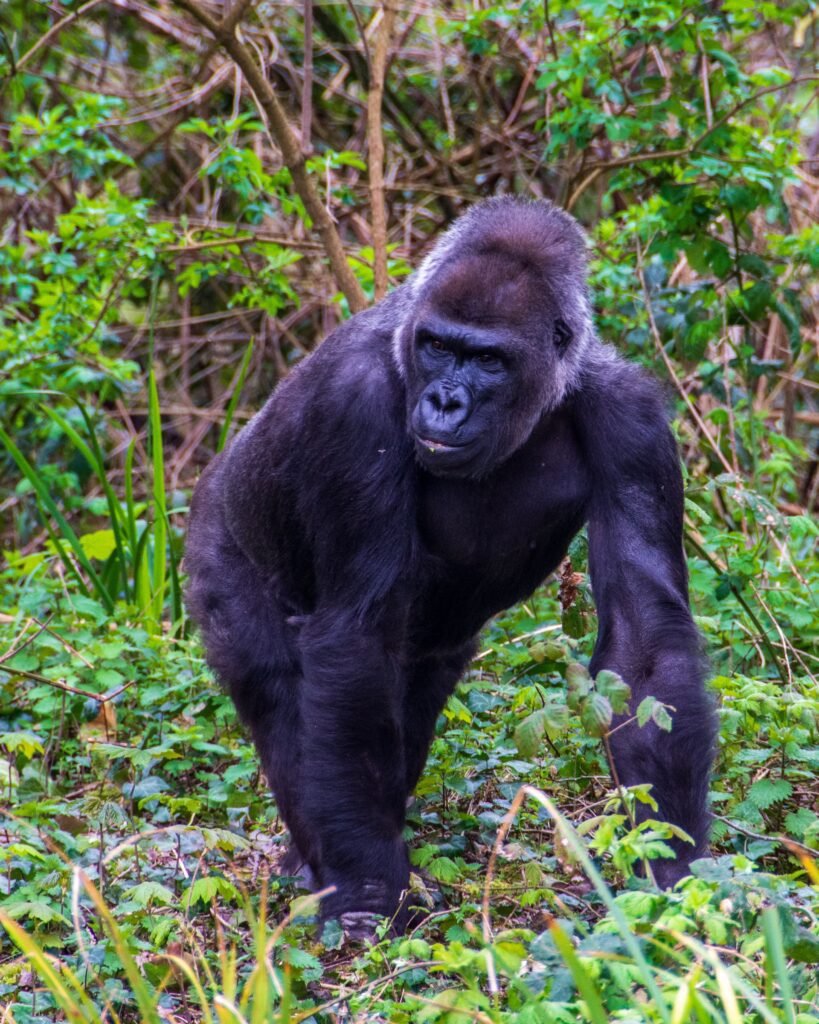
Mountain gorillas are enormous, powerful animals, but they can also appear calm and surprisingly expressive.
You may see a silverback resting nearby, young gorillas playing, mothers caring for infants or members of the family feeding and moving through the vegetation.
The experience feels very different from watching animals from a safari vehicle.
You are standing in their forest environment rather than viewing them from a road.
That closeness is precisely why strict rules exist.
How Close Can You Get to Gorillas?
You should never attempt to approach or touch a gorilla.
The required viewing distance and rules should always be followed exactly as instructed by your guides and park authorities.
Tourism Uganda currently advises a minimum distance of 5 metres in its general gorilla trekking guidance, while its Bwindi-specific page references a 7-metre rule. Because guidance can change and may vary by destination, follow the current instructions given by your guide and park authority on the day of your trek.
You should also:
- Never touch a gorilla
- Never feed a gorilla
- Never shout
- Avoid sudden movements
- Never use flash photography
- Follow your guide’s instructions
- Turn away and cover your mouth if you cough or sneeze
These rules protect both travelers and gorillas.
How Long Does a Gorilla Trek Take?
There is no single answer.
The trek can be relatively short or last several hours depending on where the gorilla family is located.
Uganda’s tourism information notes that tracking can range from less than an hour to many hours depending on the location of the gorillas.
This means you should not book a gorilla trek assuming it will be a simple one-hour forest walk.
The time spent with the gorillas is different from the total trekking time.
The hike may take hours, while the actual gorilla viewing period is limited.
In Rwanda, the official tourism guidance describes the gorilla encounter as approximately one hour.
What Should You Wear?
Choosing the right clothing can make a huge difference.
Hiking Boots
Wear sturdy, comfortable waterproof hiking boots with good grip.
The trails can be muddy and steep.
Long Trousers
Long trousers protect your legs from vegetation, insects and wet conditions.
Long-Sleeved Shirt
A long-sleeved shirt provides additional protection while walking through thick vegetation.
Waterproof Jacket
Rain can occur in forest environments even when the weather forecast looks favorable.
Tourism Uganda specifically recommends rain protection because the forests can be wet.
Gardening or Trekking Gloves
Gloves can protect your hands when using vegetation for balance.
Visit Rwanda also recommends gloves for trekkers because of the thick vegetation and stinging nettles.
Gaiters
Gaiters can be extremely useful in muddy areas and help keep vegetation and debris out of your boots.
What Should You Pack?
Keep your daypack practical rather than overloaded.
Your gorilla trekking checklist should include:
- Water
- Packed lunch or snacks
- Waterproof jacket
- Waterproof backpack cover
- Camera
- Extra batteries or power bank
- Insect repellent
- Sunscreen
- Hat
- Sunglasses
- Tissues
- Personal medication
- Small first-aid items
- Gloves
- Walking poles if needed
A waterproof bag for electronics is also a smart idea.
Rainforest weather can change quickly.
Should You Hire a Porter?
For first-time trekkers, hiring a porter can be a very useful option.
A porter can help carry your backpack and may also assist you on difficult sections of the trail.
This can allow you to concentrate more on the forest and wildlife experience rather than carrying equipment.
Porters also provide an opportunity for tourism spending to directly support people living around the protected areas.
Uganda’s tourism information notes that porters can be hired around gorilla trekking destinations.
If you need physical assistance during the hike, tell your tour operator in advance.
Can Children Go Gorilla Trekking?
Gorilla trekking has a minimum age requirement.
In Rwanda, the minimum age for mountain gorilla trekking is 15 years old.
Uganda also restricts gorilla trekking to visitors aged 15 and above.
Families traveling with younger children can consider alternative wildlife and cultural experiences.
Can You Take Photos?
Yes, photography is generally allowed, but there are important restrictions.
Flash photography is not permitted.
You should also avoid becoming so focused on your camera that you forget to experience the encounter.
A gorilla may suddenly move, look toward you or interact with another member of the family.
Sometimes the best photograph is the one you take after putting the camera down for a moment and simply watching.
What Happens If It Rains?
Do not panic.
Rain is part of the rainforest experience.
The forest can remain wet even during periods that travelers commonly consider favorable for trekking.
Uganda’s tourism authority notes that rain can occur at any time in mountainous forest areas and that trekking can become muddier during wetter periods.
This is why waterproof clothing and good footwear are so important.
A rainy trek is not necessarily a bad trek.
In fact, rain can make the forest feel even more atmospheric.
When Is the Best Time for Gorilla Trekking?
Gorilla trekking is possible throughout much of the year.
In Uganda, June through September is generally one of the major dry-season travel periods, although rain can still occur in the forest.
Rather than choosing dates based entirely on the weather, consider:
- Permit availability
- Accommodation availability
- Your overall itinerary
- Budget
- Trekking conditions
- Personal travel preferences
Even during relatively dry months, you should pack rain protection.
Gorilla Trekking Permits
A gorilla permit is required to participate in gorilla trekking.
Permit prices vary by country and can change, so travelers should always confirm the current price directly with the relevant wildlife authority or through a reputable tour operator before booking.
For Rwanda, Visit Rwanda currently lists the standard foreign visitor gorilla permit at US$1,500 per person.
Uganda has different permit pricing and promotional or resident categories may apply depending on nationality and residency.
Because prices and eligibility can change, verify the current rate before making your travel budget.
Uganda vs Rwanda: What Should a First-Timer Know?
Both Uganda and Rwanda offer mountain gorilla trekking, but the overall experience can differ.
Uganda
Uganda offers gorilla trekking in:
- Bwindi Impenetrable National Park
- Mgahinga Gorilla National Park
Uganda can work particularly well for travelers who want to combine gorillas with a broader safari.
You can add experiences such as:
- Chimpanzee trekking in Kibale
- Queen Elizabeth National Park
- Murchison Falls
- Golden monkey tracking
- Cultural experiences
Rwanda
Rwanda’s gorilla trekking takes place in Volcanoes National Park.
The park is part of the Virunga volcanic landscape and is relatively accessible from Kigali compared with some longer overland routes in Uganda.
Rwanda can be particularly attractive to travelers who want to combine gorilla trekking with:
- Kigali
- Volcanoes National Park
- Golden monkey tracking
- Nyungwe Forest
- Chimpanzee trekking
- Akagera National Park
There is no single destination that is right for every traveler. Your decision should depend on your itinerary, budget, available time and other experiences you want to include.
What If You Are Not Very Fit?
Do not automatically assume you cannot do a gorilla trek.
The important thing is to be realistic about your physical ability.
Tell your tour operator if you have concerns before your trek.
A porter can help with carrying your belongings, while guides can provide assistance during the hike.
However, gorilla trekking takes place in a natural mountain environment, so you should be prepared for uneven and potentially steep terrain.
What Happens If You Are Sick?
This is extremely important.
Gorillas are susceptible to human respiratory illnesses.
If you are experiencing a contagious illness, you should inform your tour operator and follow the current park health guidance rather than attempting to trek.
Tourism Uganda specifically states that people with communicable illnesses should not participate in gorilla trekking.
When around gorillas, cover your mouth and nose if you need to cough or sneeze and follow all health instructions from your guides.
Gorilla Trekking Etiquette
Your behavior matters.
Think of the experience as being a guest in the gorillas’ home.
Do:
- Listen to your guide.
- Keep the required distance.
- Speak quietly.
- Keep your group together.
- Follow photography rules.
- Carry your rubbish out.
- Respect the forest.
- Follow health precautions.
Don’t:
- Touch gorillas.
- Feed wildlife.
- Use flash photography.
- Shout.
- Make sudden movements.
- Leave litter.
- Try to attract a gorilla’s attention.
- Ignore your guide’s instructions.
Responsible tourism helps protect the animals and their habitat.
Is Gorilla Trekking Worth It?
For travelers who enjoy wildlife, nature and adventure, gorilla trekking offers an experience that is difficult to replicate elsewhere.
But it is important to understand what you are paying for.
You are not purchasing a guaranteed photo opportunity.
You are supporting a highly regulated wildlife experience that involves conservation, guides, trackers, local communities and protected forest habitat.
The encounter itself may last around an hour, but the memory can last much longer.
And the hike through the forest is part of the experience.
How to Make Your First Gorilla Trek Easier
If this is your first trek, these simple tips can make the experience more comfortable.
1. Train Before Your Trip
Do regular walking and hiking before traveling.
2. Break In Your Boots
Never arrive with brand-new hiking boots.
Wear them before your trek.
3. Pack Light
Take only what you genuinely need.
4. Hire a Porter
A porter can make a significant difference, particularly on steep terrain.
5. Carry Rain Protection
Do not rely entirely on the weather forecast.
6. Start Slowly
You are not racing anyone.
Walk at a comfortable pace.
7. Listen to Your Guide
Your guide and trackers know the forest and understand the gorillas’ behavior.
8. Enjoy the Forest
Do not spend the entire trek looking through your camera.
Look around.
Listen.
Take in the environment.
Final Thoughts: Your First Gorilla Trek
A gorilla trek is not an ordinary wildlife safari.
It is a physical journey into a rainforest where the wildlife determines the experience.
You may get muddy.
You may get tired.
It may rain.
You may spend hours walking before finding the gorillas.
But when you finally stand quietly in the forest and watch a mountain gorilla family going about its daily life, those challenges can become part of the story you take home.
The key is preparation.
Wear the right clothing, train before your trip, carry rain protection, listen carefully to your guide and respect the rules designed to protect these remarkable animals.
Whether you choose Uganda’s Bwindi Impenetrable National Park, Mgahinga Gorilla National Park or Rwanda’s Volcanoes National Park, a first gorilla trek can become one of the defining experiences of an East African adventure.
Ready to experience gorilla trekking for yourself? Eve On Safari can help you plan a customized Uganda, Rwanda and Tanzania itinerary combining primates, wildlife, culture and unforgettable landscapes.
Frequently Asked Questions About Gorilla Trekking
How difficult is a gorilla trek for a first-timer?
Gorilla trekking can be physically demanding because trails can be steep, muddy and uneven. Fitness preparation and appropriate hiking equipment are recommended.
How long does gorilla trekking take?
The total trek varies depending on where the gorilla family is located. The actual viewing period is limited, while the hike to and from the gorillas can take considerably longer.
What should I wear for gorilla trekking?
Wear sturdy hiking boots, long trousers, a long-sleeved shirt, gloves and waterproof clothing. Gaiters can also be useful.
Can I take pictures of gorillas?
Yes, photography is generally allowed, but flash photography is prohibited. Always follow your guide’s instructions.
What happens if it rains during a gorilla trek?
You continue with appropriate rain protection unless your guide or park authorities advise otherwise. Rain is common in rainforest environments, so waterproof clothing is essential.
What age can you be to go gorilla trekking?
The minimum age is generally 15 years for gorilla trekking in Uganda and Rwanda. Always confirm current requirements when booking.
Should I hire a porter?
A porter can be particularly helpful for carrying your daypack and assisting on challenging terrain. Hiring one also supports local employment around the protected area.
Can I combine gorilla trekking with a Tanzania safari?
Yes. A Uganda or Rwanda gorilla experience can be combined with a Tanzania safari covering destinations such as Serengeti, Ngorongoro and Tarangire, followed by Zanzibar for a beach extension.