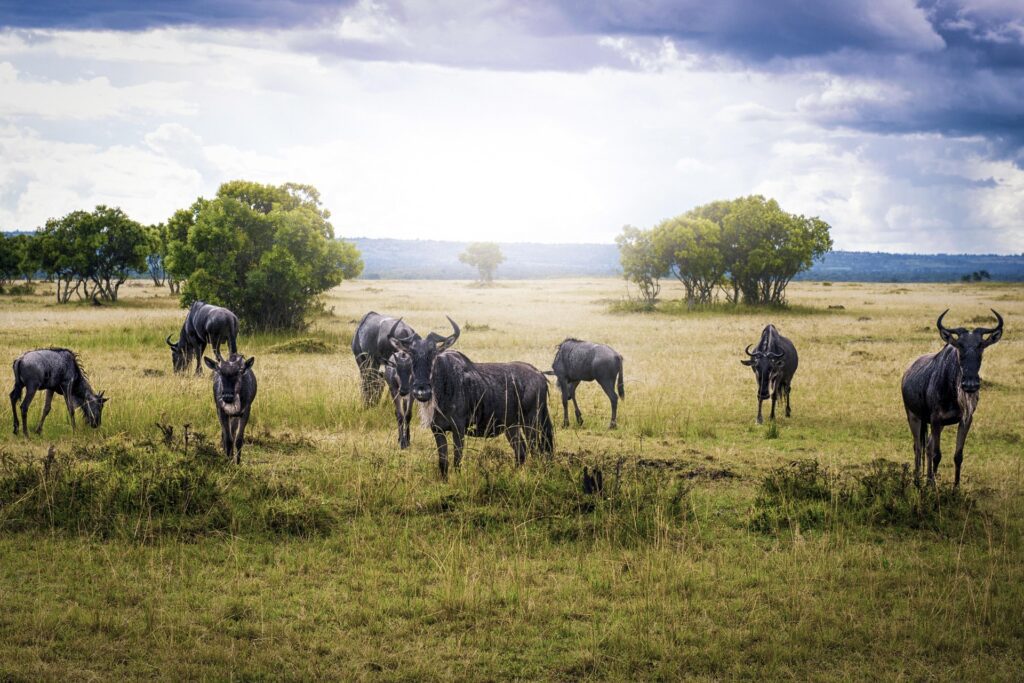
What Is the Great Migration?
The Great Migration is a continuous annual movement of huge herds of wildebeest, accompanied by zebras and other grazing animals, across the Serengeti-Mara ecosystem.
The animals move in response to changing rainfall, water and grazing conditions. The migration therefore does not follow an exact calendar every year.
The cycle includes calving in the southern Serengeti, movement through the central and western parts of the ecosystem, the journey north toward the Mara, and the eventual return south into Tanzania.
This is why choosing between Serengeti and Maasai Mara depends heavily on when you are travelling.
Serengeti vs Maasai Mara at a Glance
| Feature | Serengeti, Tanzania | Maasai Mara, Kenya |
|---|---|---|
| Migration ecosystem | Southern and central part of the wider ecosystem | Northern section of the ecosystem |
| Main migration experience | Calving, large herds and movement across the Serengeti | Northern migration and Mara River crossings |
| Peak migration interest | Varies by season and location | Generally July to October for the northern migration |
| Wildlife | Excellent year-round wildlife viewing | Excellent year-round wildlife viewing |
| Big cats | Lions, cheetahs and leopards | Lions, cheetahs and leopards |
| Landscape | Vast plains and diverse Serengeti landscapes | Open grasslands, riverine areas and rolling plains |
| Safari style | Large ecosystem with many areas to explore | Compact reserve with strong wildlife viewing |
| Best suited to | Travelers wanting a longer Tanzania safari experience | Travelers focused on the Mara and northern migration |
The timing of the migration varies from year to year, so these periods should be used as general planning guidelines rather than guarantees.
Serengeti: The Tanzanian Side of the Migration
The Serengeti is one of the central destinations associated with the Great Migration.
The park forms a major part of the wider Serengeti-Mara ecosystem and offers wildlife experiences beyond the migration itself. Tanzania’s official tourism website highlights the Serengeti’s vast plains, wildlife and role within the country’s northern safari circuit.
One advantage of choosing the Serengeti is that your safari does not have to revolve exclusively around the migration.
You can combine migration viewing with opportunities to see:
- Lions
- Leopards
- Cheetahs
- Elephants
- Giraffes
- Buffalo
- Hippos
- Zebras
- Wildebeest
- Many bird species
The Serengeti is also particularly relevant earlier in the migration cycle, including the calving period in the southern Serengeti.
The Serengeti Calving Season
January through March is associated with the calving period in the southern Serengeti.
This can be an interesting time for travelers who want to see young wildebeest and increased predator activity rather than focusing specifically on river crossings.
The exact timing and location of wildlife activity varies according to rainfall and environmental conditions.
Maasai Mara: The Kenyan Side of the Migration
The Maasai Mara forms the northern part of the Serengeti-Mara ecosystem.
The migration typically reaches the Mara during the northern movement, with July to October commonly associated with the dramatic migration period in Kenya.
The Mara is particularly famous for the Mara River crossings.
During these crossings, wildebeest gather at the riverbanks before attempting to cross the water. Crocodiles and strong currents add to the natural hazards faced by the animals.
However, it is important to understand that a river crossing is never guaranteed on a particular day.
The herds may remain on one side of the river for hours or days, and their movements depend on weather, grazing conditions, water levels and other natural factors.
Serengeti vs Maasai Mara: Where Can You See the River Crossings?
If your primary goal is to photograph the famous Mara River crossings, the Maasai Mara and northern Serengeti are the areas to consider.
The migration enters Kenya from northern Tanzania, and the Mara River is one of the major obstacles encountered during this part of the journey.
Northern Tanzania also offers access to sections of the migration route around the Mara River.
For travelers who want to focus on this event, choosing the correct location and travel dates is more important than simply choosing Tanzania or Kenya.
Which Side Has Better Wildlife?
Both destinations offer excellent wildlife viewing.
The Maasai Mara is known for its high concentration and variety of wildlife, while the Serengeti offers a much larger ecosystem with extensive plains and different wildlife habitats.
Rather than asking which destination has “better” wildlife, consider what you want to see and how you want to spend your safari.
If your main interest is the migration itself, timing and location are critical.
If you want a broader safari covering multiple landscapes and wildlife destinations, the Serengeti can be combined with other northern Tanzania destinations such as Ngorongoro and Tarangire.
Serengeti vs Maasai Mara for Big Cats
Both the Serengeti and Maasai Mara are well known for big-cat sightings.
Visitors may encounter:
- Lions
- Leopards
- Cheetahs
The presence of large concentrations of migrating herbivores can also create opportunities for predator activity.
The Maasai Mara is particularly known for its predator populations, while the Serengeti provides a vast landscape in which predator-prey interactions occur throughout the ecosystem.
Wildlife sightings are never guaranteed, however, and responsible safari operators should avoid promising specific animals.
Serengeti or Maasai Mara: Which Is Better for Photography?
Both destinations offer excellent photography opportunities.
Choose the Serengeti if you want:
- Vast open landscapes
- Large herds against expansive horizons
- A longer Tanzania safari itinerary
- Migration and non-migration wildlife experiences
- Opportunities to combine the Serengeti with Ngorongoro and Tarangire
Consider the Maasai Mara if you want:
- The northern migration
- Mara River crossing opportunities
- Open grassland wildlife photography
- A safari focused on the Mara ecosystem
- Opportunities for additional safari experiences available around the reserve
The Maasai Mara also offers a range of safari experiences, including game drives, walking experiences in surrounding areas, horseback activities and hot-air balloon safaris.
When Is the Best Time to See the Great Migration?
There is no single month that guarantees the best migration experience.
The migration is a year-round ecological cycle, and different stages occur in different parts of the ecosystem throughout the year.
January to March
The southern Serengeti is associated with the calving season.
This period can be interesting for travelers who want to see newborn animals and predator activity.
April to May
The herds continue moving through the Serengeti as the ecosystem responds to seasonal rainfall.
This period can offer greener landscapes and, depending on conditions, fewer visitors.
June
The herds begin moving northward as conditions change.
The exact location of the herds varies from year to year.
July to October
This is the period most commonly associated with the northern migration and Mara River crossings.
Kenya’s official tourism information identifies July to October as the main period for experiencing the migration in the Maasai Mara.
November to December
The herds begin moving south again as the annual cycle continues.
Should You Visit Both Serengeti and Maasai Mara?
For travelers with enough time, combining both sides can provide a broader understanding of the migration ecosystem.
A cross-border itinerary can allow you to experience the Serengeti in Tanzania and the Maasai Mara in Kenya.
However, this requires additional planning around:
- Border crossings
- Flights or road transfers
- Park and reserve fees
- Accommodation
- Vehicle arrangements
- Travel time
For many travelers, choosing one side and spending more time exploring it can also provide a rewarding safari.
Serengeti vs Maasai Mara: Which One Should You Choose?
There is no single answer for every traveler.
Choose the Serengeti if your priority is:
- A Tanzania safari
- Combining migration viewing with other northern Tanzania destinations
- The southern Serengeti calving season
- Large landscapes and an extensive ecosystem
- A longer Tanzania wildlife itinerary
Choose the Maasai Mara if your priority is:
- The northern migration
- Mara River crossing opportunities
- A safari focused on the Mara ecosystem
- Visiting Kenya
- Combining wildlife viewing with other Kenyan destinations
Choose both if:
You have enough time and want to experience different sections of the Serengeti-Mara ecosystem.
Why Migration Timing Matters More Than the Country
One of the biggest mistakes travelers make when planning a migration safari is choosing a country first and checking the migration location later.
The herds do not follow a fixed schedule.
Rainfall, grazing conditions and water availability influence their movements, so the exact location can change from year to year.
For this reason, your safari operator should plan the itinerary around the likely location of the herds during your travel dates, rather than simply advertising a generic “migration safari.”
Plan Your Tanzania Migration Safari with Eve On Safari
If you want to experience the migration from the Tanzanian side, Eve On Safari can help you plan a safari around the Serengeti and other northern Tanzania destinations.
Your itinerary can be tailored around:
- Travel dates
- Migration season
- Safari duration
- Accommodation category
- Private or group travel
- Photography interests
- Serengeti areas
- Ngorongoro and Tarangire extensions
Call or WhatsApp: +255 768 611 005
Email: info@eveonsafari.com
Eve On Safari
Tanzania safari experiences planned around your journey.
Frequently Asked Questions
Is the Serengeti or Maasai Mara better for the Great Migration?
Neither destination is universally better. They are different sections of the same ecosystem, and the most suitable choice depends primarily on your travel dates and the part of the migration you want to experience.
When is the migration in the Maasai Mara?
The northern migration is generally associated with July through October, although exact timing varies from year to year.
When can I see the migration in the Serengeti?
The migration is present within the Serengeti ecosystem throughout the annual cycle, but its location changes throughout the year. January to March is associated with calving in the southern Serengeti, while the herds move north later in the year.
Are Mara River crossings guaranteed?
No. River crossings are natural events and cannot be guaranteed on a particular date. Herd movements depend on environmental conditions.
Can I see the Big Five in the Serengeti?
The Serengeti supports populations of major African wildlife, including lions, elephants, buffalo and leopards. Sightings vary depending on location, season and natural conditions.
Can I combine Serengeti and Maasai Mara?
Yes. It is possible to design an itinerary that includes destinations in both Tanzania and Kenya, although additional transport and border logistics need to be considered.
How long should I spend on a migration safari?
The ideal duration depends on your objectives. A longer stay provides more flexibility to follow wildlife movements and explore different areas rather than relying on a single game-drive opportunity.