Big Cats of the Serengeti: Where to Spot Lions, Leopards, and Cheetahs
The Serengeti National Park is one of Tanzania’s most famous wildlife destinations, with vast plains that support an extraordinary variety of animals. Among the most exciting sightings are the Serengeti’s big cats: lions, leopards and cheetahs.
Each species has different habits, preferred habitats and hunting strategies. Knowing where and when to look can make your game drives more rewarding.
Whether you are planning your first Tanzania safari or returning for another wildlife adventure, understanding the behavior of these predators can help you appreciate every sighting.
The Serengeti is part of Tanzania’s northern safari circuit, alongside destinations such as Ngorongoro and Tarangire. The Tanzania Tourist Board describes the Serengeti as a major wildlife and plains destination within this circuit.
The Serengeti: A Big-Cat Paradise
The Serengeti’s combination of open grasslands, woodland, rocky areas and seasonal water sources creates habitat for a wide range of predators and prey.
The movement of wildebeest, zebras and other herbivores also creates changing opportunities for predators throughout the year.
This means there is no single place where you are guaranteed to see all three big cats.
Instead, your safari guide will use knowledge of the landscape, recent sightings, animal tracks and wildlife behavior to decide where to explore.
And that is part of the excitement of a Serengeti safari.
You never know what might be waiting around the next bend.
1. Lions of the Serengeti
Lions are among the most recognizable animals in Africa and one of the species many travelers hope to see during a Serengeti safari.
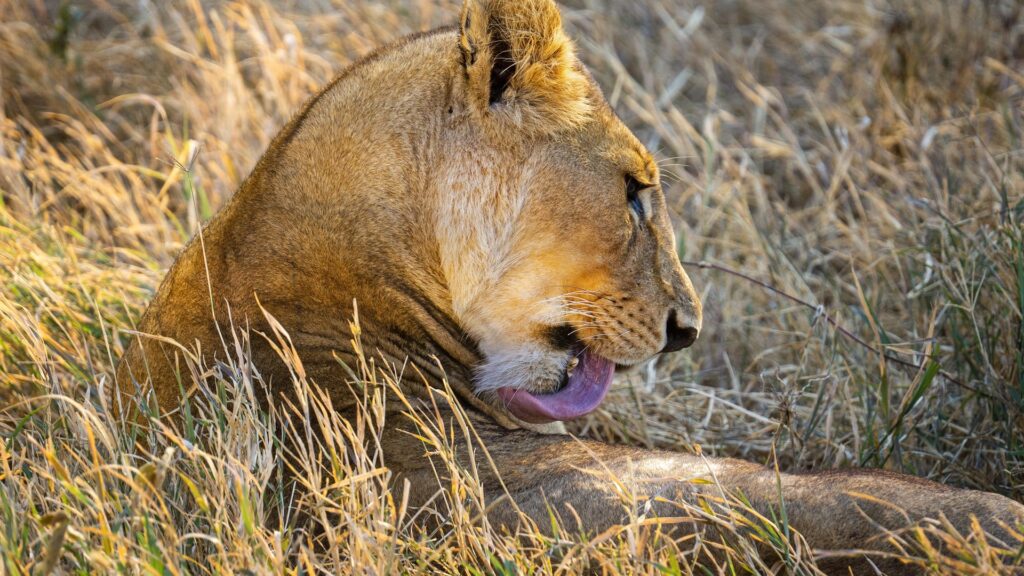
Unlike leopards and cheetahs, lions often live and hunt in social groups called prides.
They can spend significant parts of the day resting, especially when temperatures are high.
Where to Look for Lions
Lions can be encountered across different parts of the Serengeti.
Open grasslands are particularly important because they provide habitat for the large herbivores that lions depend on.
Your guide may also look around:
- Open plains
- Areas near concentrations of wildebeest and zebras
- Riverine areas
- Wooded sections
- Rocky outcrops
- Areas where recent lion activity has been reported
The exact location of prides changes regularly, so a knowledgeable guide is important.
Best Time to See Lions
Early morning and late afternoon are often productive periods for wildlife viewing.
These cooler hours can be more comfortable for both animals and visitors.
Lions may also be resting during the hotter middle part of the day, sometimes in shade.
If you find a pride resting beneath a tree, do not assume there is nothing happening.
Watching the animals interact, groom one another or care for cubs can be just as interesting as watching a hunt.
2. Leopards of the Serengeti
Leopards are among the most elusive animals in the Serengeti.
Their solitary nature, camouflage and preference for resting in vegetation can make them more difficult to find than lions.
A leopard can be sitting only a short distance from a safari vehicle and remain almost invisible.
Where to Look for Leopards
Leopards often favor areas where trees and vegetation provide cover.
When exploring the Serengeti, your guide may check:
- Acacia trees
- Riverine woodland
- Thick bushes
- Rocky areas
- Seasonal watercourses
- Trees along river channels
One of the classic leopard sightings is an animal resting high in a tree.
Leopards are powerful climbers and may use trees to rest, protect food from scavengers or survey their surroundings.
How to Find a Leopard
Finding a leopard requires patience.
Rather than looking only at ground level, scan the branches of large trees.
Look for:
- A curved tail hanging from a branch
- Spotted fur against the leaves
- A movement in the canopy
- A carcass stored in a tree
- Other animals reacting to something nearby
Your safari guide’s experience can make a major difference because guides often know which habitats are regularly used by leopards.
3. Cheetahs of the Serengeti
Cheetahs are built differently from lions and leopards.
They are specialized for speed and are generally associated with open habitats where they can use their acceleration to pursue prey.
The Serengeti’s wide plains can provide suitable hunting grounds.
Where to Look for Cheetahs
When searching for cheetahs, your guide may focus on open grasslands and areas where smaller and medium-sized prey are present.
Possible areas to explore include:
- Open plains
- Short-grass areas
- Areas frequented by gazelles
- Flat grassland with good visibility
Cheetahs can sometimes be easier to spot in open country because they may sit or stand prominently against the grass.
However, they can also disappear quickly into the landscape.
Best Time to See Cheetahs
Morning and late afternoon can be productive periods for wildlife viewing.
Cheetahs may also become active when temperatures are more manageable.
If a cheetah begins hunting, the action can unfold quickly.
This is why keeping binoculars and cameras ready is important.
Lions vs Leopards vs Cheetahs
Understanding their differences can help you identify what you are seeing during a game drive.
| Feature | Lions | Leopards | Cheetahs |
|---|---|---|---|
| Social behavior | Often live in prides | Mostly solitary | Mostly solitary |
| Preferred habitat | Grasslands and varied habitats | Woodland, riverine areas and cover | Open grasslands |
| Hunting style | Group and individual hunting | Ambush predator | High-speed pursuit |
| Activity | Often active around cooler periods | Frequently active at different times | Often active during cooler periods |
| Tree climbing | Cubs and some adults can climb | Excellent climbers | Generally not known for climbing |
| Body pattern | Tawny coat | Rosettes | Solid spots |
| Main visual clue | Mane in adult males | Rosette pattern | Black tear marks and spotted coat |
Where Are the Best Areas for Big-Cat Sightings?
There is no single guaranteed “big-cat zone” in the Serengeti.
The location of predators changes with prey movements, water availability, vegetation and other environmental conditions.
For this reason, it is better to plan a safari that gives you multiple days in the Serengeti rather than relying on one game drive.
The Tanzania Tourist Board highlights the Serengeti as a major destination for wildlife and plains experiences, while current northern-circuit itineraries commonly include Serengeti game drives as a central part of the safari experience.
Central Serengeti
The central Serengeti around the Seronera area is a popular safari region because of its combination of plains, riverine vegetation and wildlife habitat.
The area can offer opportunities to look for all three major big cats.
The landscape also provides access to a variety of other wildlife, making it useful for travelers who want a broad Serengeti experience rather than focusing exclusively on one species.
Southern Serengeti
The southern Serengeti is particularly associated with seasonal wildebeest movements and calving periods.
Large concentrations of herbivores can attract predators.
For travelers interested in predator-prey interactions, the timing of a visit can therefore be important.
The exact location and intensity of wildlife activity changes with rainfall and seasonal conditions.
Western Serengeti
The western areas of the Serengeti offer a different landscape, with woodland and riverine habitats.
These environments can provide opportunities for leopard sightings as well as other wildlife.
Depending on your travel dates, the western corridor can also be relevant to travelers following seasonal wildlife movements.
Northern Serengeti
Northern Serengeti provides another distinct safari environment and can be especially interesting during the northern phase of the annual wildebeest migration.
Predators follow prey movements, but they do not necessarily remain in one place simply because the migration is passing through.
A good guide will therefore combine seasonal knowledge with current wildlife observations.
The Best Time of Day for Big Cats
If big cats are your priority, consider including both morning and afternoon game drives.
Early Morning
The cooler conditions can bring increased animal activity.
It is also a beautiful time for photography because the early light creates softer colors and long shadows.
Midday
Wildlife may become less active during the hottest hours.
This does not mean sightings stop completely. You may still encounter animals resting, drinking or moving between shaded areas.
Late Afternoon
As temperatures begin to fall, wildlife activity can increase again.
This is another good period to look for predators.
What About Night?
The Serengeti has a fascinating nocturnal ecosystem, but standard game drives inside national parks are generally governed by park regulations and operating hours.
If you are interested in seeing nocturnal wildlife, ask your safari operator whether a night game drive is available in the specific conservation area or private concession included in your itinerary.
Night drives can offer opportunities to see species that are rarely active during daylight, but they are a different experience from a standard Serengeti game drive.
Tips for Finding Big Cats on Safari
1. Listen to Your Guide
Your guide is not simply driving the vehicle.
They are constantly observing tracks, animal behavior, other vehicles and the surrounding landscape.
2. Bring Binoculars
A leopard lying beneath a distant tree may be difficult to see with the naked eye.
Binoculars can turn a small shape into a clear wildlife sighting.
3. Be Patient
Some of the best sightings require waiting.
A lion pride may be resting for an hour before suddenly becoming active.
4. Look Beyond the Road
Animals are not always beside the vehicle.
Scan the grasslands, trees and distant hills.
5. Keep Your Camera Ready
Wildlife encounters can happen quickly.
Having your camera prepared means you are less likely to miss the moment.
6. Avoid Expecting a Checklist
A safari is not a guarantee that you will see lions, leopards and cheetahs in one day.
Wild animals move freely.
The goal is to experience the ecosystem, not simply collect sightings.
Big Cats and the Wildebeest Migration
The Great Migration can influence predator activity because millions of grazing animals move through the wider Serengeti-Mara ecosystem during their annual cycle.
Wildebeest and zebras provide an important food source for predators.
However, the migration does not mean that predators will automatically be found at every crossing or herd.
Wildlife movements remain unpredictable.
If migration is important to you, your safari should be planned around the season and likely location of the herds, while allowing time for general wildlife viewing.
Photographing Lions, Leopards and Cheetahs
The Serengeti is an exceptional destination for wildlife photography.
For big cats, consider bringing:
- A telephoto lens
- Extra batteries
- Extra memory cards
- Binoculars
- Lens-cleaning equipment
- A beanbag or other stable support if permitted
- A camera with good low-light performance
Avoid shouting or making unnecessary movements to attract an animal’s attention.
The best wildlife photographs usually come from patience and observation rather than trying to create a reaction.
Responsible Big-Cat Viewing
Seeing a lion, leopard or cheetah is exciting, but responsible wildlife viewing should always come first.
During your safari:
- Follow your guide’s instructions
- Keep a respectful distance from wildlife
- Do not feed animals
- Do not attempt to attract predators
- Avoid loud noises
- Stay inside the vehicle unless your guide confirms it is safe and permitted
- Do not encourage the vehicle to block an animal’s path
- Respect other safari vehicles and visitors
A good safari experience should allow you to observe wildlife without unnecessarily disturbing it.
Plan Your Big-Cat Safari with Eve On Safari
If lions, leopards and cheetahs are high on your Tanzania safari wish list, Eve On Safari can help you design an itinerary around the Serengeti and other northern Tanzania destinations.
A longer stay can give you more opportunities to explore different habitats and follow current wildlife activity.
Your safari can also be combined with destinations such as Ngorongoro Crater and Tarangire National Park. Tanzania’s official tourism information identifies Serengeti, Ngorongoro and Tarangire as key destinations within the northern safari circuit.
Call or WhatsApp: +255 768 611 005
Email: info@eveonsafari.com
Eve On Safari
Tanzania safari experiences designed around your journey.
Frequently Asked Questions
Where is the best place to see lions in the Serengeti?
Lions can be encountered in many parts of the Serengeti. Open grasslands and areas with abundant prey can be productive, but their location changes regularly.
Where can I see leopards in the Serengeti?
Leopards are often associated with areas containing trees, riverine vegetation and other cover. Your guide may search around wooded areas and trees where leopards can rest.
Where can I see cheetahs in the Serengeti?
Cheetahs are commonly associated with open grasslands where they can use their speed to hunt. Your guide may search areas with good visibility and suitable prey.
What is the best time to see big cats?
Early morning and late afternoon can be productive periods for wildlife viewing, although predators can be encountered at different times of the day.
Can I see all three big cats in one day?
It is possible, but there is no guarantee. Wildlife moves freely and sightings depend on natural conditions, season and location.
Are lions, leopards and cheetahs part of the Big Five?
Lions and leopards are part of the traditional Big Five. Cheetahs are not included in the traditional Big Five list.
How many days should I spend in the Serengeti for big cats?
Spending several days in the Serengeti gives you more opportunities to explore different areas and encounter different wildlife. The ideal length depends on your overall Tanzania itinerary and budget.